Hanami 3.0: In full bloom

On this page
From the very beginning we set out to make Hanami a different kind of Ruby framework: clear, modular, and built to grow. Today it comes into full bloom. We’re thrilled to share Hanami 3.0 with you!
This release rounds out the framework with three big new features: mailers, internationalization, and Minitest. On top of that, your apps are now faster by default, and your developer experience is sharper, from your logs all the way to your assets.
First-class mailers
Our long lost gem is back! Hanami apps now come with integrated mailers, which feel right at home next to your actions, views, and operations.
Mailer classes describe everything you need to deliver an email:
from "welcome@bookshelf.test"
to { user.email }
subject { "Welcome to Bookshelf, !" }
expose :user
end
end
end
As standalone objects, mailers are injectable via the Deps mixin and accessible wherever you need them. Call .deliver and the mailer will use your input to prepare headers and render mail body templates, which work as a fully featured extension of your view layer.
Mailers support multiple delivery methods. SMTP delivery works out of the box: populate some env vars for your SMTP host and you’re good to go. In test, your emails are accumulated in memory for you to inspect.
If you need something more, you can also write your own delivery methods. In addition to a clean interface for these, Hanami Mailer provides hooks for threading delivery options all the way through your mailers, allowing new delivery methods to make the most of special features offered by email delivery providers.
Like all our gems, Hanami Mailer is also designed for standalone use. Check out the comprehensive README for everything you need to know about using it in your Ruby app.
Hanami Mailer leans on the venerable mail gem to handle all its low-level mail wrangling. Thank you to the mail maintainers for all their work over the years!
Built-in internationalization
Taking your apps to the world just got easier: i18n is now built right into Hanami. Bundle the i18n gem and Hanami sets up a self-contained translation backend in your app and every slice, with translate and localize helpers ready to use across your actions and views.
Your translations live in config/i18n/ in your app or slice:
# config/i18n/en.yml
en:
  posts:
    index:
      title: "Latest posts"
    create:
      created: "Your post is live!"
  greetings:
    welcome: "Welcome, %{name}!"
From there, i18n helpers are everywhere you’d expect them! Like in your views:
<%# app/templates/posts/index.html.erb %>
And your actions:
# app/actions/posts/create.rb
response.flash[:notice] = t(".created")
# ...
end
And for everywhere else, the "i18n" component is just one Deps mixin away:
include Deps["i18n"]
i18n.t("greetings.welcome", name:)
end
end
We’ve got localization too. localize formats your dates and times for the current locale, and ships with sensible defaults for English:
localize(Date.new(2026, 5, 22))
# => "Fri, 22 May 2026"

localize(Time.new(2026, 5, 22, 9, 5), format: :short)
# => "22 May 9:05 am"
Like every aspect of Hanami, i18n is designed to work out of the box with minimal setup, but there are plenty of settings if you need something custom. Check out the i18n guide for the full picture.
You can’t spell internationalization without the i18n gem, which does all the heavy lifting for this new feature. So a big en-AU “cheers, mates” to the i18n maintainers — thank you for helping Rubyists the world over!
Now with Minitest
Hanami has always shipped with a ready-to-go RSpec setup. We’re delighted we can finally make the other half of you happy, thanks to our brand new Minitest support!
Pick your testing framework when you generate an app:
$ hanami new my_app --test=minitest
RSpec stays our default, but reach for Minitest and you’ll now get an equally complete setup, rather than having to build something yourself.
A big thank you to Ryan Davis and all the contributors for their work on Minitest. Minitest ships with Ruby itself, and we’re glad to make it part of the Hanami story going forward.
Faster by default
Hanami 3.0 is significantly faster, and you can enjoy the benefits right from the get-go. In a test app, the same request runs around 3.7x faster over HTTP while allocating a fraction of the memory.
Hanami now memoizes your components by default. This means that each component in your app’s containers is resolved just once and then reused, rather than built fresh every time it’s needed.
This is the change you’ll really feel. We took an app whose action resolves a graph of nine components and renders a view, then measured the same request on 2.3 and 3.0. In 3.0, there were 14x fewer allocations per request and around 3.7x the throughput over HTTP (and closer to 9x throughput when measured in-process, where the server isn’t the bottleneck). Tail latency dropped too: p99 reduced from 20ms to 4ms as the per-request allocation churn and GC pauses went away.
We also focused on improving performance across the hottest parts of the framework:
- Hanami Action snapshots each action’s config up front rather than recomputing it per-request, and overall allocates far less per request. A minimal action drops from 88 allocations to 14 — that’s 84% fewer — and runs around 4.5x faster in isolation.
- Hanami View gets the same config snapshot treatment, and also no longer decorates exposures by default. A minimal render drops from 88 allocations to 39 and runs around 2.9x faster.
The best part of all this? It’s a free lunch! Upgrade to 3.0 and your apps simply run faster, on less memory, all without any changes to your code.
A special thank you to Sean Collins for driving much of our performance work for 3.0. We love you 3.7x more than before!
Clearer, more useful logs
We’ve given logs some love for 3.0, across both day-to-day development and production.
In development, logs are now colorized by default. SQL statements are formatted to match your request logs, and they’re also syntax highlighted when the rouge gem is bundled.
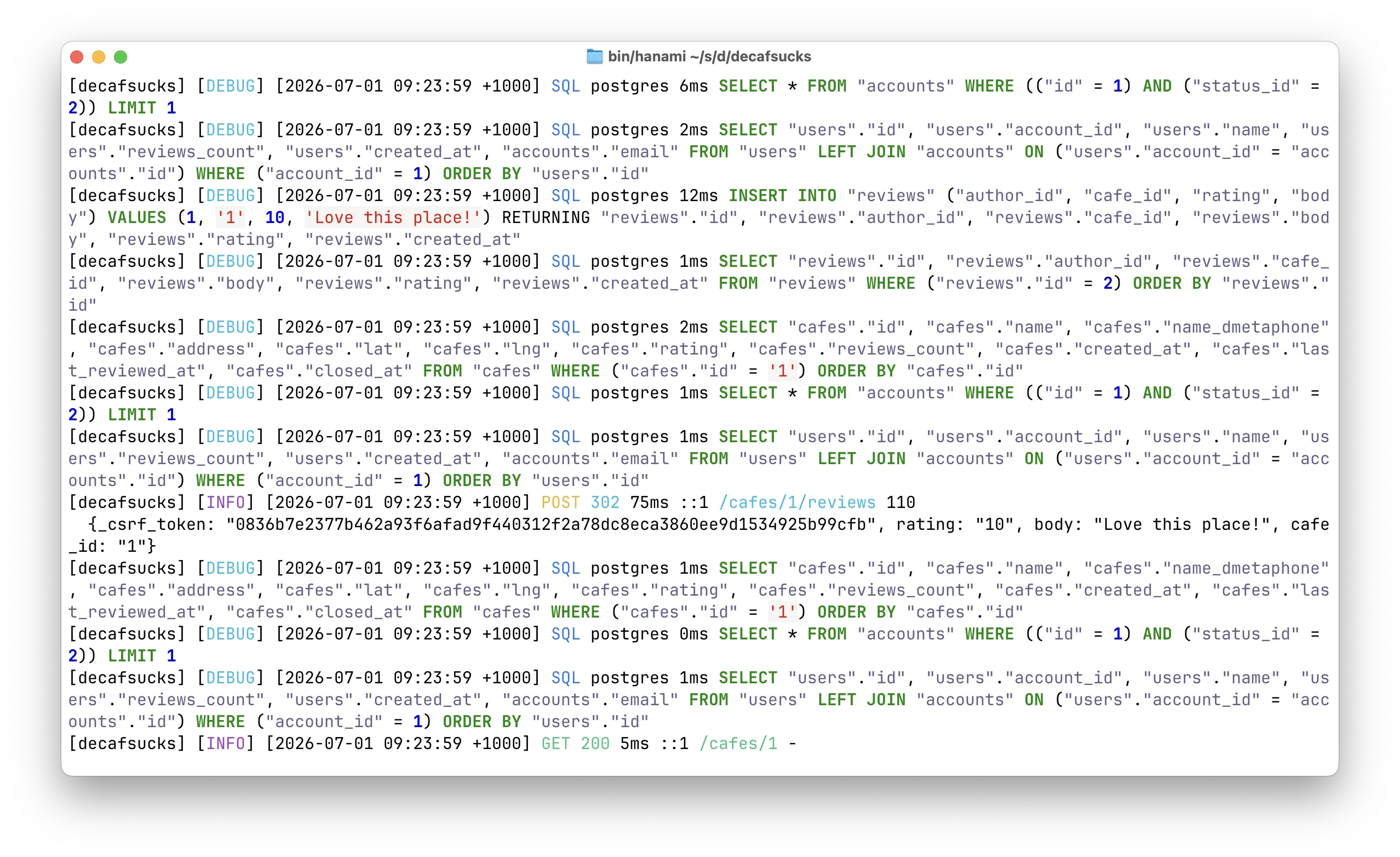
SQL statements now log at the :debug level rather than :info, for quieter production logs, and you can tune this with config.db.log_level.
You can also conveniently set the log level from the env with HANAMI_LOG_LEVEL, which takes precedence over any config in your app class.
Underneath, Hanami now guarantees a consistent interface for its logger (even if you configure a third-party replacement), so you can always count on:
- Structured logging, via keyword args passed to the standard log methods.
-
Tagged logging, via
#taggedblocks.
Read our revamped logger guide to learn more.
Smoother asset watching
hanami assets watch now keeps pace with more of your work: it picks up newly added and removed entry points, and reacts to changes in static assets like images and fonts. In earlier versions, each of these meant restarting the watcher. Now it just keeps up, so you can stay in the flow!
We also published a spec covering how any asset bundler can plug cleanly into Hanami. Our own bundler is based on esbuild, but we don’t want you to feel locked in! We’d love to see you bring your favorite bundler to Hanami.
Body parsing comes to Hanami Action
Hanami’s request body parsing has moved out of middleware and into Hanami Action, where it’s now driven by your formats config. Your actions parse exactly the formats you accept, and you can configure this right alongside the rest of your content negotiation.
Parsers for multipart form bodies and JSON work out of the box. And if you need something else, you can register your own:
formats.register(:custom, "application/custom", parser: ->(body, env) { ... })
Learn more in our formats and media types guide.
Simpler views with undecorated exposures
View exposures are now undecorated by default. Your templates receive exactly what you expose, with no decoration unless you ask for it. This is a more predictable default, and avoids extra work when decoration isn’t strictly required.
When you do want to decorate, the new .decorate method makes those exposures stand out in your code. You can also bring back the old behaviour across a view with config.decorate_exposures = true.
A cleaner foundation
A major new version is a chance to put the house in order:
-
hanami-controller is now hanami-action. The gem name finally matches the classes we’ve been using for years. Require it as
hanami-actionorhanami/action. - hanami-validations has been retired. Hanami Action now reaches for dry-validation directly for your action’s params and contracts, with one fewer gem in between.
Hanami 3.0 also requires Ruby 3.3 or newer.
The result is fewer moving parts, clearer names for the gems we use, and a more approachable Hanami overall.
And much more!
We’ve landed plenty of smaller refinements in 3.0 too:
- New
hanami generate providerandhanami generate mailergenerators. - A
--forceoption across all generators, to overwrite existing files instead of stopping. - A
--nameoption forhanami new, to set the app namespace separately from the directory path:hanami new my_bookshelf --name=bookshelf. -
--gem-source=gem.coopforhanami newinstalls gems from our gem.coop namespaces. - Generated apps require Puma 7.1 and drop app preloading boilerplate from
config/puma.rb. - A
--template-engineoption forhanami newandhanami generatecreates templates for the given engine (erb,haml, orslim). Set a project-wide default withconfig.default_template_enginein your app class. - Explicit redirect helpers in the router:
permanent_redirect(301) andtemporary_redirect(302), with plainredirectnow requiring an explicitcode:argument for clarity. -
Hanami::Settings::CompositeStorefor chaining settings lookups across multiple stores. -
Hanami::Slice.with_slicesreturns a slice together with all its nested slices. - Hanami View exposes the currently-rendering template name as
Hanami::View::Scope#template_nameandHanami::View::Context#current_template_name(this supports our relative i18n key lookups). - Raise a helpful error when a slice is called as a Rack app with no routes available.
- Various fixes: multipart uploads to the router, URL generation with array variables, duplicate routes on
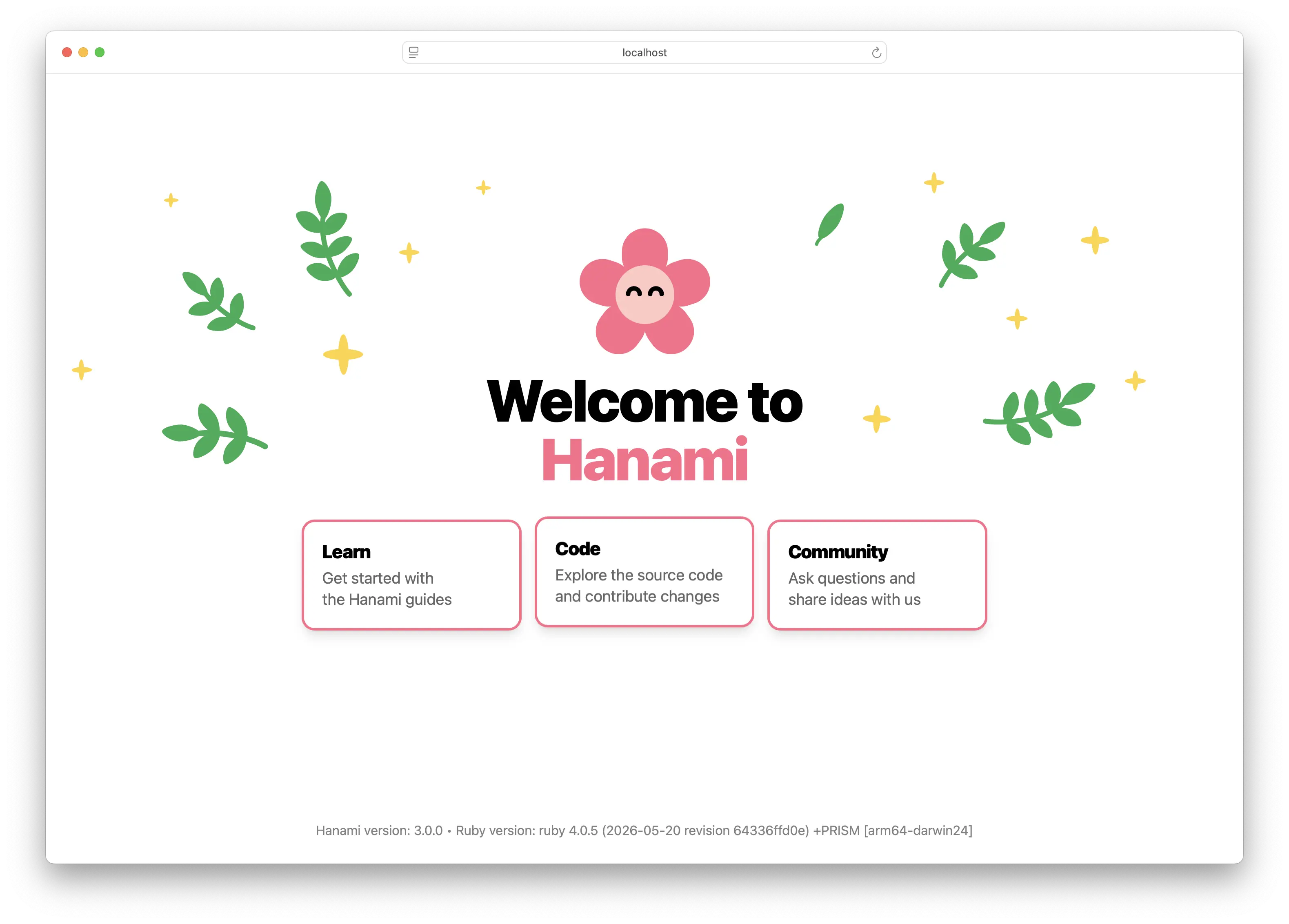
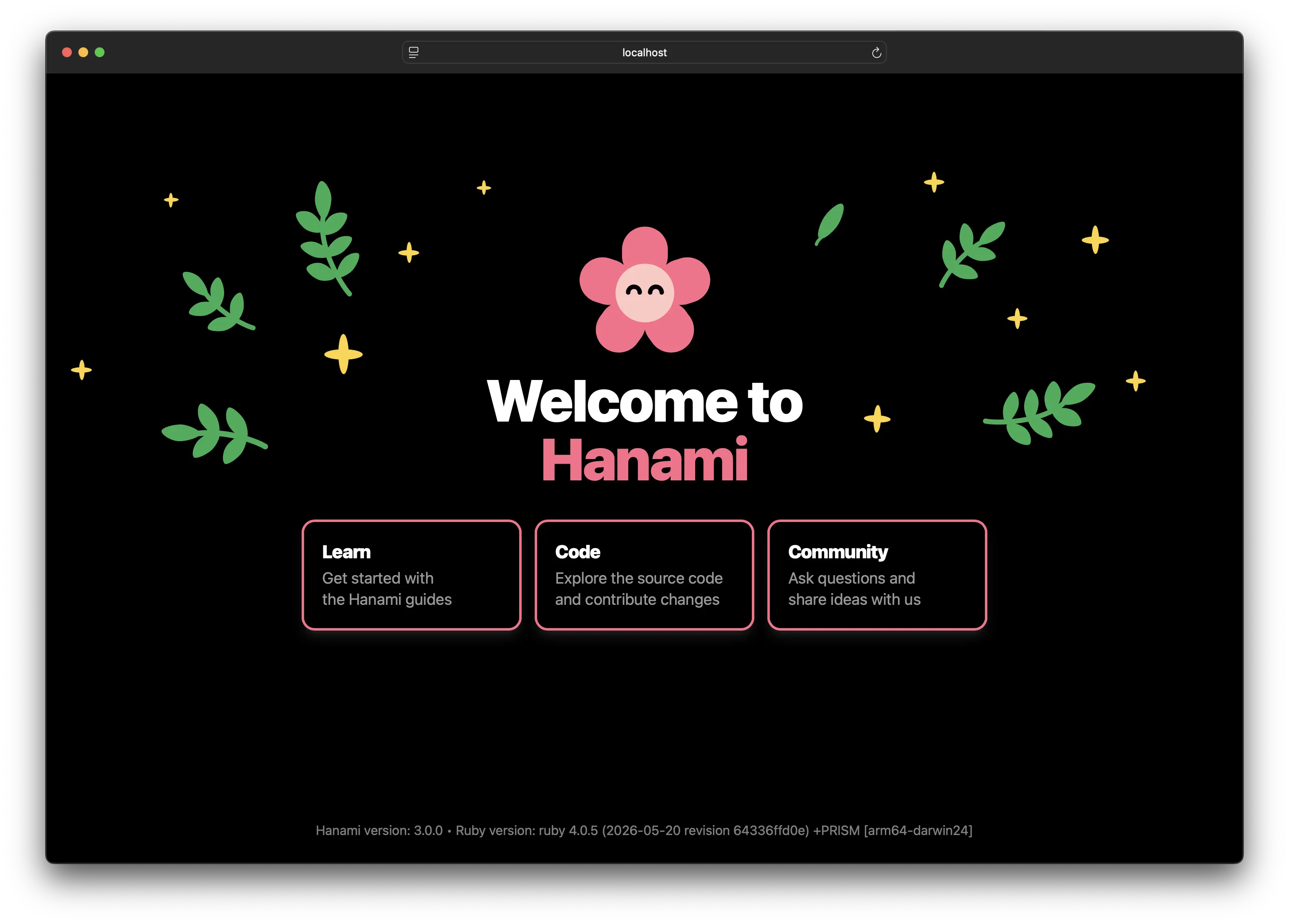
generate action, and more. - A beautiful new welcome screen, matching our Hanakai visuals. (Thank you Max!)
Try it out
You’re only a few commands away from a new Hanami 3.0 app:
$ gem install hanami
$ hanami new my_app
$ cd my_app
$ bin/hanami dev
$ open http://localhost:2300
We’d love to hear how you go! Come say hi in our forum or our chat. Our community is super friendly and always willing to help you on your Hanami journey.
Upgrading from 2.3
Already on 2.3? Our 3.0 upgrade notes walk you through every step.
Thank you to our contributors!
Thank you to everyone who contributed to this release:
- Aaron Allen
- Adam Lassek
- Carolyn Cole
- Edouard
- Jane Sandberg
- Joshua Young
- Konstantin Haase
- Kyle Plump
- Matthew Stanton
- Max Wheeler
- Paweł Świątkowski
- Philip Arndt
- Ramón Valles
- Sean Collins
- Tim Riley
- Wout
- Yi Sangwon
Thank you to our sponsors!
This release is another huge step forward for Hanami, and there’s no way we could have done this without the support of our sponsors. Thank you, from the bottom of my heart!
Thank you to our business sponsors:
- Sidekiq, our Platinum sponsor.
- Brandon Weaver, our Gold sponsor.
- Honeybadger, FastRuby.io, AppSignal and SerpApi, our Silver sponsors.
And thank you to all the individuals supporting Hanakai through GitHub Sponsors and Open Collective. Your encouragement means the world!
Hanami is in full bloom today, but a garden is never finished, and there’s plenty more we want to grow. Your support is what makes that possible. We’d love for you to become a sponsor.